
Cold LinkedIn outbound has a reputation problem, and it's deserved. Most of what lands in people's inboxes is either a thinly veiled template or a piece of fake personalization (think 'I loved your recent post!') that fools no one. The result is reply rates that hover in the low single digits and a channel that burns trust faster than it builds pipeline.
At NoBooth we run outbound differently, and the numbers reflect it: we consistently reach 30% reply rates for the clients we work with. This isn't a growth-hack or a clever subject line. It's a system, a repeatable way of finding the right reason to reach out to the right person, built on five tools that each do one job well: Apollo, Sayintel, AI research agents, Claude Code, and HeyReach.
The one principle behind all of it
We never personalize for the sake of personalization. Every message exists because we found a genuine, specific reason that this person should care right now. If we can't find that reason, we don't send.
Why most personalization fails
There's a common belief that personalization is about proving you did your homework. So reps mention the prospect's hometown, their dog, or a conference they attended. It feels personal, but it's noise. It doesn't connect to a reason to buy. Worse, at scale it becomes a mail-merge field, and prospects can smell it instantly.
Relevance is different. Relevance means the message speaks to something the prospect is actively dealing with: a strategic priority, a hire they're trying to make, a shift in their market. When you lead with relevance, personalization stops being decoration and becomes the message itself.
Personalization is the 'how.' Signals are the 'why.'
The entire system is built around signals: observable, public evidence that a company or person is in a moment where what our client offers actually matters. We don't guess. We look for proof.
The signals we hunt for
Which signals matter depends entirely on who we're working with. A client selling AI infrastructure cares about completely different evidence than a client selling compliance tooling. Part of our job is knowing, for each client, exactly which signals predict a real need. A non-exhaustive list of what we look for:
- AI initiatives or AI strategy mentioned in earnings reports, investor calls, or annual filings, a strong signal that budget and executive attention are moving.
- Relevant job postings. Hiring for a role tells you what a team is about to invest in before they've built anything.
- A prospect's most recent LinkedIn posts. What someone publicly chooses to talk about is the clearest window into what's on their mind this quarter.
- How a company explains its AI products. The language, maturity, and gaps in their own positioning reveal where they need help.
- Cloud strategy analysis: migration announcements, multi-cloud commitments, or platform consolidation that change what a team needs.
- Leadership changes, funding events, product launches, and market expansions, the moments that reset priorities and open windows.
Depending on who we work with, we know which of these signals to look for and, just as importantly, which to ignore. A signal is only valuable if it connects to a reason the prospect should respond. Everything else is trivia.
The stack: five tools, five jobs
1. Apollo: data enrichment and AI research
Apollo is where it starts. We use it for two things. First, data enrichment: building precise, tightly-scoped lists of the exact people who match our client's ideal customer profile, with clean, verified contact and firmographic data. Second, AI research on those accounts. Not bloated lists of thousands, but the right accounts and the right roles within them. Clean targeting at the top means everything downstream is sharper.
2. Sayintel: scraping for speakers and signals
Sayintel.com is our scraping layer, and it's especially powerful for conference-driven outbound. We use it to scrape speaker lists and attendee-adjacent data from the events our clients care about, and to pull the public signals (talks, panels, topics) that tell us what a prospect is going to be focused on. If someone is speaking about their AI roadmap at a summit next month, that's not trivia. That's the opening of a conversation.
3. AI research agents: signal discovery at scale
This is where the signals get depth. We run AI research agents to investigate accounts and people at scale, surfacing the earnings mentions, job postings, recent LinkedIn posts, product positioning, and cloud strategy shifts that tell us whether there's a real reason to reach out. The agents do the breadth; they read far more than any human could in the time available. Humans decide what it means.
4. Claude Code: personalization and quality audits
Claude Code is how we tie it together. It implements the personalization itself, turning verified signals into message variants grounded in those specific signals. It loads the APIs of our data vendors so enrichment, scraping, and research flow into one pipeline instead of a pile of spreadsheets. And critically, it runs our messaging quality audit process: every draft is checked programmatically against our standards before a human ever reviews it. It lets a small team operate with the consistency and throughput of a much larger one, without losing the per-prospect specificity that makes outbound work.
5. HeyReach: dynamic variables, sent safely at scale
HeyReach is where the campaigns actually run. It enables us to send LinkedIn messages with dynamic variables, so every message carries its prospect-specific, signal-based personalization, at high quality and with the account safety that makes this sustainable rather than a one-time burn. Multiple sender accounts, deliverability guardrails, and the sending infrastructure that turns careful research into campaigns that compound instead of getting accounts flagged.
Why this combination works
Apollo enriches the data and researches the accounts. Sayintel scrapes the speakers and signals. AI research agents find the reason to reach out. Claude Code turns the reason into a personalized, audited message. HeyReach delivers it with dynamic variables, safely and at scale. No single tool gets you to 30%. The system does.
The part nobody talks about: 70% of our time is QA
Here's the number that surprises people. When we run AI-assisted outbound, roughly 70% of our time is not spent generating messages. It's spent on quality assurance. AI makes it trivially easy to produce volume. It does not make it easy to produce quality. That gap is exactly where most AI outbound falls apart, and exactly where we invest.
Every signal gets verified. Every message gets checked against a simple bar: is this genuinely relevant to this specific person, right now, or is it personalization theater? If a draft references a signal that's stale, misread, or irrelevant, it gets cut. We would rather send fewer messages that are unmistakably relevant than flood inboxes with plausible-sounding noise.
- Signal verification: is the signal real, current, and correctly understood?
- Relevance check: does the signal actually connect to a reason this person would care?
- Message review: does the copy lead with the reason, not with flattery or filler?
- Account safety: are sending volumes and patterns keeping our clients' accounts healthy?
This is the standard we hold for our clients, and it's non-negotiable. AI is a force multiplier on both quality and garbage. The QA layer is what decides which one you ship.
What our clients say
NoBooth is the rare partner that truly understands the Data and AI space. They know how to get the best results in a short time, which is why we keep working together conference after conference. Snowflake Summit 2026 in Las Vegas was a huge success thanks to them.
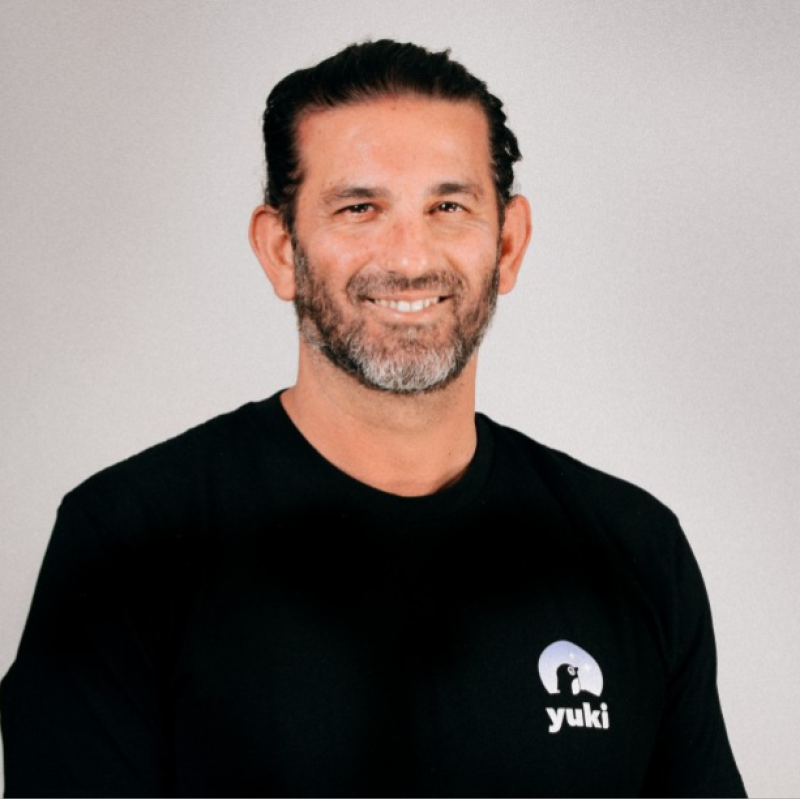
Perry Tapiero
Head of Marketing, Yuki
Why we're sharing this
Honestly, we're tired of hearing founders say conferences don't work or that the ROI isn't there. In almost every case, the event wasn't the problem. The preparation was. People show up hoping for serendipity instead of arriving with a system: the right targets, the right signals, and a real reason to talk to each person they want to meet.
That's the gap we exist to close. None of this is magic, and none of it is locked behind a single tool. It's relevance, discipline, and a quality bar you refuse to drop. If you're a startup that's been burned by an event, it probably wasn't a waste. It was a missed opportunity to show up prepared, and that's exactly what we help with.
We're sharing the system because we want more teams to stop blaming the channel and start fixing the preparation. If any of this resonates, we'd love to talk. Itai and Dennis, NoBooth.
About NoBooth
NoBooth helps tech companies win at conferences without buying a booth. Instead of spending six figures on a stand that gets walked past, we use signal-based outbound to book the meetings that actually matter before, during, and after the event. The conference becomes a reason to connect, not a line item.
The company was built by Dennis Luks and Itai Manor, who first met at Sisense. Dennis spent years in enterprise sales at MongoDB, JFrog, and Sisense, learning firsthand how much pipeline gets left on the table at events. Itai is the founder of Revhub, the Middle East's largest revenue community, and brings deep roots in the go-to-market world. They built NoBooth together to turn the way they'd always wanted to run conference outbound into a repeatable system.
We don't personalize to look like we did our homework. We personalize because we found a real reason for this person to care. That's the whole game.